
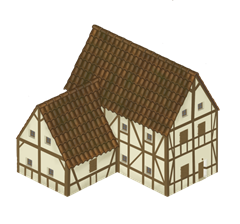
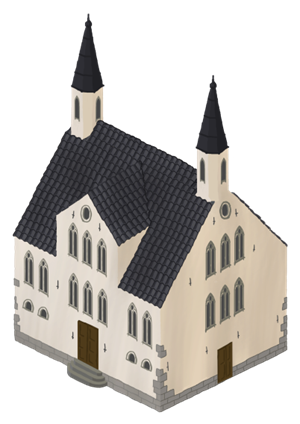
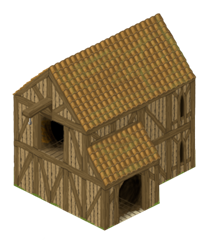
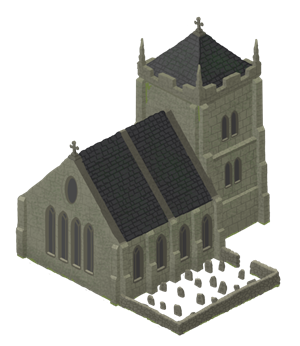
The capital and the provinces serve the same war, but they should not feel like copies of one another. The capital is a place the player shapes visually. Provinces are strategic holdings that must stay quick to inspect during a turn.
The capital is a physical town
The capital scene uses an isometric tile space. Buildings occupy rectangular footprints measured in whole tiles, while their sprites can have separate visual offsets so doors, walls and foundations sit correctly over the ground. Flipping a rectangular structure swaps its occupied width and height rather than only mirroring the image.
That sounds like a technical detail, but it changes how construction feels. A town hall needs to reserve the land its art appears to use. Wall sections need to connect cleanly. A longhouse should rotate into a street without blocking invisible tiles somewhere else.
The current catalogue already distinguishes civic, housing, defense and infrastructure choices. Town halls, warehouses, residences, churches, walls, towers and gates have authored labels, textures, footprint sizes and placement rules. A dedicated footprint editor lets us tune the occupied tiles and the rendered position together.
Buildings should explain their role
The visual catalogue is larger than the first gameplay set, so not every attractive sprite needs a unique mechanic. We are defining future building roles around administration, population, storage, military production, defense and support. Variants can then represent tiers or visual variety without creating dozens of nearly identical rules.
The intended model makes the Town Hall the city-center progression structure, housing the source of population growth, storage the support for construction and campaigns, and walls and gates a defensive investment. Those economic and military effects are not connected to placed capital buildings yet. Training, research, diplomacy and commander management are also possible later links, not current capital mechanics.
Provinces stay intentionally compact
Province state already records ownership, level, local storage, population, weekly production, taxation, garrison capacity and stationed units. The proposed development model keeps three clear building roles: the local resource building, a population building and a garrison building.
- Resource development improves the province's output and local storage.
- Population development raises the people and levy capacity available there.
- Garrison development unlocks and strengthens local defense and recruitment.
Keeping those roles limited is deliberate. A realm with many provinces should create priorities, not a long maintenance checklist. The player should be able to see which border needs soldiers, which resource province deserves investment and which settlement can safely wait.
Design boundary: free placement belongs to the capital. Province development belongs to the campaign map. Both influence the same economy, but they solve different player problems.
Connecting economy to war
Resources already change campaign decisions. Recruitment spends gold and population, with iron added for higher-level soldiers. Healing wounded armies spends food. Weekly province production fills local storage up to its capacity, and stored resources can be consumed by campaign actions.
The next connection is the capital itself. Its building choices should eventually prepare armies, improve logistics and unlock options that are felt when the next turn begins. Likewise, conquering a valuable province should feed back into what can be built at home. That bridge remains design work rather than a finished loop.
What is implemented and what is still design work
Isometric placement, roads, building footprints, flipping and moving placed structures, the capital catalogue and the underlying province economy data are present now. Capital building costs and effects, the complete progression curve, final balance and every connection between capital buildings and province output are still being designed and tested.
Being explicit about that distinction is useful. It lets us validate the city-building interaction before locking the economy around it, and prevents the website from presenting a planning document as a finished feature.